Learning on the job at Raider Graphics
On the clock after school

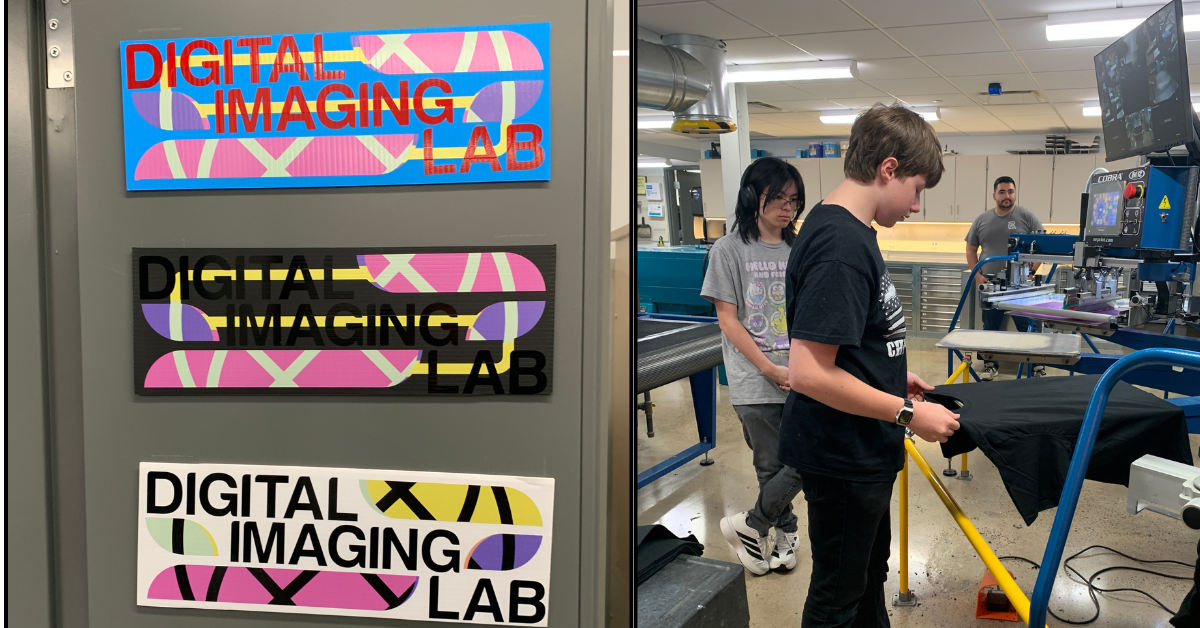
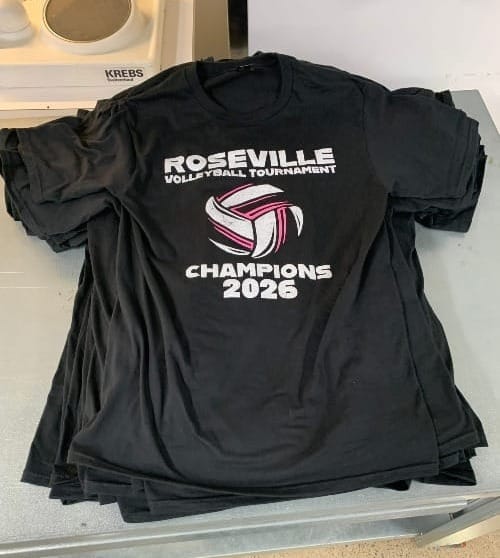
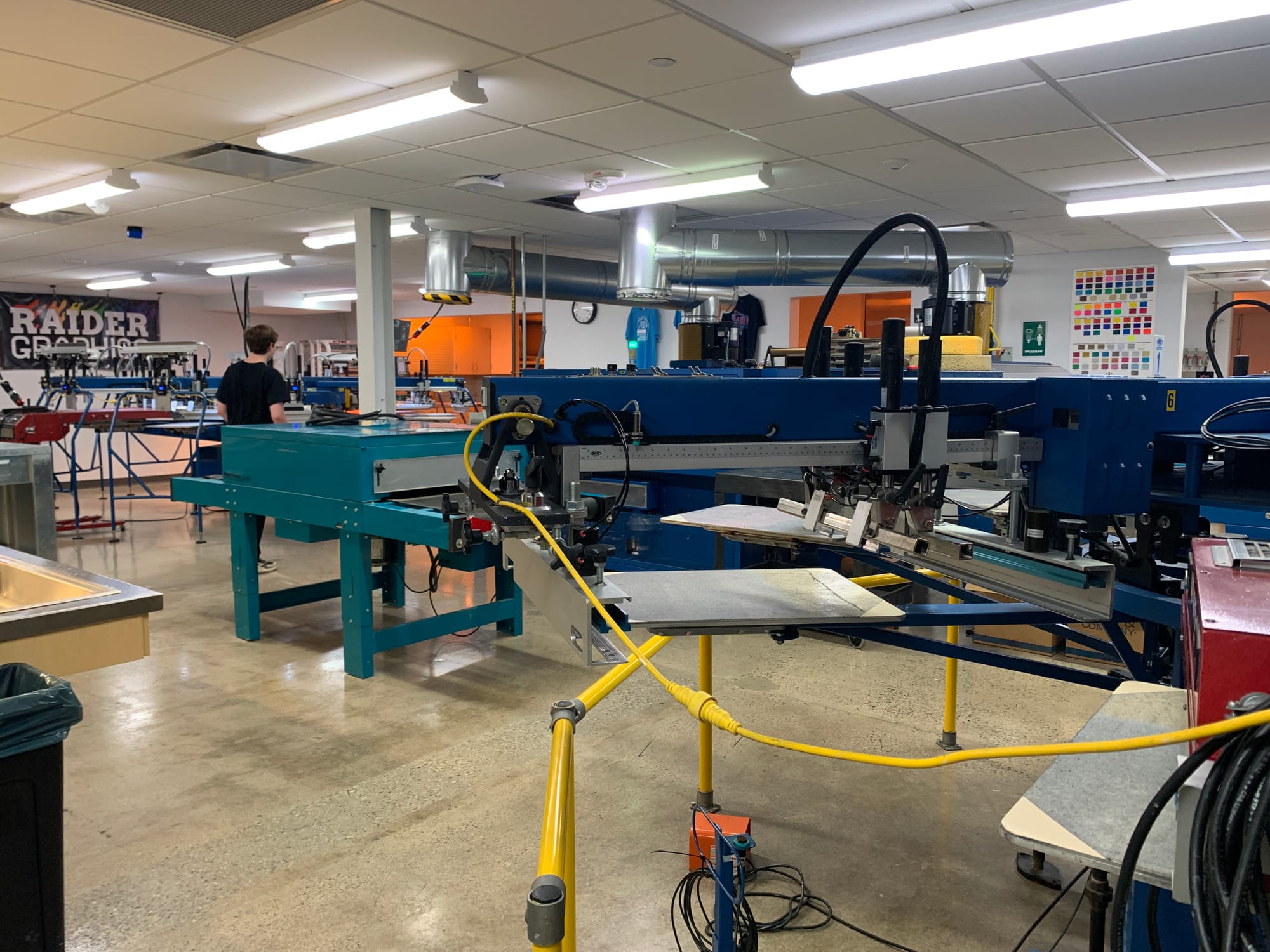
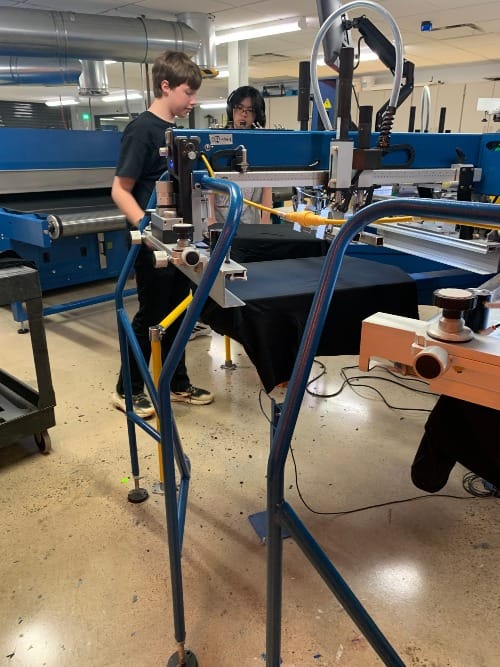
The printing press at Roseville Area High School is a substantial piece of machinery. Shirts travel around it in an open circle, stopping to receive ink before making their way through a conveyor dryer that looks like an industrial-sized version of Costco’s pizza oven. Seniors Gavin and Colin work together at the press, loading shirts, keeping an eye on the equipment and enjoying each other’s company. They’re making two-color shirts for the winners of an upcoming volleyball tournament.
The shop is surprisingly tidy. Machines, tables and boxes of shirts fill the room, but nothing feels cluttered. The floor is gleaming white, and overhead lights come on as people move around. There’s a steady hum from the equipment, interrupted by the occasional rattle of the press.
Gavin explains that there’s a little room for error when loading a shirt. “You got a half inch before people notice.” Setting up the press is another matter. “There’s like—it’s like a ten-step process in order to actually get this set up,” he says. Something can go wrong at any one of them. “It breaks everything.” Still, he’s confident about his own abilities. “I’m actually pretty good at my job, if I do say so myself.”
Colin takes a more matter-of-fact approach. “I’m just here to do the work, get paid, learn on the way.”
Both are paid employees of Raider Graphics, a working print shop tucked inside Roseville Area High School. They come in after school to fill customer orders.
Colin found his way into the program through Intro to Media Arts, a class he signed up for because it sounded interesting.
“I like arts class, so I’ll see what this is about,” Colin remembers thinking. “It was completely random. I had no idea that it would end up like this.” A friend already working at Raider Graphics eventually got him interested in the job.
Gavin started partly because he needed a fine arts credit. He learned to print on manual presses in class before moving on to the much larger automatic equipment in the shop. Asked whether working at Raider Graphics feels like the rest of his school day, he doesn’t hesitate. “It’s certainly not school.”
There are plenty of things to learn. Screens have to be prepared, lined up, cleaned and reclaimed. Shirts have to go onto the press correctly. A mistake early in the process can cause trouble several steps later.
Colin learned that on his second day, when he put a heat transfer on backward. Instead of transferring onto the shirt, it stuck to the heat press. The machine couldn’t be used for the next few days while it was cleaned.
Asked whether he’s made mistakes on customer orders, Colin doesn’t hesitate. “Oh, yeah. Many times.”
Sam Joyce teaches Communication Technology at RAHS and advises Raider Graphics. His classrooms sit alongside the production shop, where students can take several levels of print-design classes. The earlier classes, Joyce says, are “still school world.” By Print Design 3, the distinction begins to disappear.
“Those students are effectively doing the same thing that a professional would do if you were working on a floor in a print shop,” Joyce says.
Joyce sometimes sees the same students through five or six classes, enough time to notice who’s interested in the work or has a knack for it. Some eventually move into paid positions in the shop.
Shamus Barrett, who manages the production operation, is quick to distinguish his role from Joyce’s. Asked if he’s the teacher, he corrects the assumption: “Production manager out here, actually.”
Barrett came to RAHS from the commercial printing industry, where he managed a screen-printing shop. He handles the customers, orders and production at Raider Graphics, and he’s eager to bring in more business.
“I would love more,” he says.
“We will take orders from just about anybody,” Barrett adds. That could mean matching shirts for a family vacation, an order for a sports team, or something for a local business or nonprofit.
Gavin has a fairly broad description of what they make: “We print stuff.” As he points out, “I don’t do enough just T-shirts to say I print T-shirts.”
There are sweatshirts, banners and vinyl signs, along with transfers for hats, bags and smaller shirt orders. Once a job is set up, the automatic press can turn out hundreds of shirts an hour.
After school jobs
The students generally work an hour and a half or two hours after school. Barrett doesn’t want them there all night. They have homework.
But these are productive hours. Barrett says the shop makes fewer errors than the commercial operation he previously managed, something he attributes partly to the checks built into the process and partly to keeping everything clean and organized.
Students can prepare customer jobs, but Barrett gives the final approval before production begins. If an expensive mistake follows, the responsibility ultimately belongs to him.
There are other expectations. Punch in. Sign your time sheet. Tell your boss if you’re not coming to work. Forget to sign your time sheet before payroll closes and your paycheck may have to wait.
“The program has paid for their own machines,” Barrett says. “All of that stuff has been bought by us doing jobs for customers.”
The arrangement goes back more than three decades to former teacher Brian Hoag, who came to education from the printing industry. Hoag wanted better equipment for the program, but professional printing machines were expensive.
Barrett sums up Hoag’s solution: “Start a business. Make that money and then spend it on the program.”
And that’s what they’ve been doing ever since.
Back at the press, Gavin and Colin have volleyball shirts to finish. Over the school speaker comes an announcement that someone’s ride is waiting at the front door. Then the machines start up again.
Want to order from Raider Graphics?
Raider Graphics accepts orders from individuals, teams, nonprofits, businesses and school groups. Orders typically start at 12 pieces for one-color shirts, with prices around $10.50–$11 per shirt, depending on the order. Turnaround is generally about two weeks. Contact Shamus Barrett directly to discuss an order at shamus.barrett@isd623.org or 651-724-5896.
Editorial note: First names were used for the students, at their request. The Roseville Reader defers to student and parent preference when identifying minors in articles.